
Artivism Now
by Alex Liu (any pronouns)
The visual sense is one of our most dominant senses, and it's most apparent in the creative, visual arts. From its inception in ancient caves, to the Renaissance revolution, to the modern internet age, art has been so prevalent in our lives. Art has long fueled our imaginations and expressiveness, so much so that creativity is often seen as a pillar of our humanity, something unique to us as a species. A role that the arts have that fewer know, however, is in advocacy.
The arts in social justice often shock, and then start dialogues. They beckon for hard questions to be asked and answered. They place empathy and humanity into subjects so often seen as inhumane in news headlines. They provide a different platform for those that cannot write or speak, to tell others.
But as our social justice efforts have focused on other mediums such as physical protests and written petitions, the visual arts have become secondary to free speech protections. Now in a political climate that seeks to silence speech and advocacy, the arts have become a prime target in Los Angeles. In this newsletter, I hope to discuss the history of muralism and Chicano art in Southern California, how it has been tied to political power and voices in the immigrant communities of Los Angeles, and how censorship is impacting the voices of our immigrant community in Pomona.
The Koreatown Case
Students at the Robert F. Kennedy Community Schools in Koreatown, Los Angeles returned from winter break to an unusual sight: a blank wall of their gymnasium. Here once stood the school’s most defining feature: a painted mural in honor of Hollywood actress Ava Gardner. Its removal in late 2018 sparks a debate surrounding how public art can act as a medium of free speech, how public art has become the voice of entire communities of immigrants in Southern California, and what must be done to protect the arts from mounting political pressures today.
The school’s mural on its own was rather innocent. The artwork, made by local artist Beau Stanton, featured prominent ArtDeco styling, most particularly the rays of color emitting from around Gardner’s head. Such rays became the subject of protest and controversy, as residents of the Korean-American community found such visual elements a close resemblance of Japan's rising sun. Such a symbol is closely tied to the Imperial Army and its war crimes in Korea, but was something far from the artist's intention.
As discussed by The Los Angeles Times art critic Christopher Knight, Not In My Backyard activists are unable to come to rationale with the artwork. The mural is not reasoned to be a terrible coincidence, rather it is insisted upon as a true symbol of Japanese imperialism, a purposeful offense to the Koreatown community (Knight). This forceful attitude to remove the mural creates a sense that these activists have underlying motivations beyond simply removing offensive imagery, but to further project on the Koreatown community their power and influence. Instead of resolutions such as modifying the mural’s design or changing the ray’s colors, protests led on by activists demanded the mural’s complete removal, something the school’s administration would follow through over the winter break of 2018.

Such action has been deplored by the media, with Knight reasoning that the removal of this mural was an act of censorship “weaponized to shut down free speech” (Knight). That is what murals indeed are; a medium of speech meant to be enjoyed and seen by all of the public at any time. Murals are a medium to be analyzed, and criticised, for certain. But not outright removed and slandered without any due process.
Knight would further put doubt over activist claims by highlighting the prominence of ArtDeco style throughout other public art works in the city, finding “stylized light beams in nostalgic wall murals is hardly surprising. See, for example, the extravagant star and sunburst decorations over the doorways of the Eastern Columbia Building downtown. Indeed, the motif is all over the city — in the ceiling at the Hollywood Pantages Theatre, on the doors of the Oviatt Building in the financial district, on the pyramid atop the Central Library, in the Wiltern theater a couple blocks west of RFK Schools and many more" (Knight).

The prevalence of these same rays and ArtDeco styles further suggests that activist demands to remove the school mural feels targeted and deliberate in reshaping the dynamics of Koreatown’s community. The removal of the Ava Gardner mural was not a pledge to honor the history of Korean-Japanese relations, it was a move by the activist group to gain more legal traction in their broader politics of resisting new development such as homelessness rehabilitation (Knight). To the Not in My Backyard activists, creative expression by independent artists was reduced to nothing more than a pawn.

In 2021, the mural would fortunately be restored by the school and its students, with resolutions that modified the ray’s colors, and now include imagery of diversity and the Korean immigrant community. But while this mural has a happy conclusion, the entire case provides a concerning precedent for other public art works in Los Angeles that may speak to a political message.
Knight, when referencing a specific letter of complaint sent from the activist group to the school, finds that the letter even goes so far as to imply that the artist meant to terrorize its neighborhood. Such a claim "requires proof of harmful intent to qualify a mural for removal, which is a direct attack on the artist’s integrity” (Knight). With the school district formally endorsing such baseless claims in the first place, it opens the door for other artists and their hard work to become the victims of smear campaigns and falsified claims. In other words, in a political scene becoming increasingly polarized and oppositional, public art is under threat from campaigns that seek to erase free speech.
David Siqueiros: A Historical Perspective
The Koreatown case would not be so significant if it weren't for Los Angeles's well-established muralism scene to begin with; a scene with foundations in political activism nearly a century ago.
In fact, one of the city’s most famous works symbolizes the continuous struggle to freely create works that stood for social justice, David Alfaro Siqueiros’s “América Tropical”, created in 1932. Having recently sought refuge in the United States from prosecution in Mexico, Siqueiros was commissioned by the Los Angeles Chicano community of Calle Olvera to promote happy, prosperous Mexican migrant worker life.
Siqueiros completely ignored instructions to instead paint a far more controversial message.

Featuring pre-Columbian ruins of Mexico surrounded by armed individuals, Siqueiro’s final work centers on a crucified Native American, underneath an American bald eagle. Chicano art historian Shifra Goldman recalls in her research paper regarding Siqueiros, that the mural was applauded in the art world for its bold imagery, but laments that “its powerful indictment of U.S. imperialism and exploitation could not be tolerated” (Goldman). Siqueiros's work demonstrates how bold art styles often come from ideas meant to confront and challenge, and that activism can motivate creativity just as well as aesthetics. In Siqueiros's work he made clear his support of Socialist ideas, Mexican revolutionaries of the time, and the consumption of art to inform the public. A staunch opposer to American colonialism and influence in Mexican politics, Siqueiros’s mural only deepened the artist’s legacy of creating art that connected with politics, and fought for the justice of his fellow migrant workers. In his own words, he “knew that his first duty before aesthetic concerns was to fulfill the expression of his ideology" (Siqueiros).

"América Tropical" was a media storm and of high controversy, and Siqueiros would soon leave the United States, leaving the mural to be covered up soon after. Even in the mural’s short lifespan however, its impact on the Chicano community in Los Angeles was already set in motion, as "América Tropical" became one of the origins of the Chicano muralist movement.
San José State University Chicano studies professor Dr. Juan Pablo Mercado, contextualizes Siqueiro’s work in the broader movement of expression from Los Angeles’s Chicano movements, who came to resent the ignorance of their social and economic needs. For them, “the mural then came to represent, at least in the eyes of young Chicano and Chicana artists and activists, another glaring example of the inability of racist institutions to allow expressions of Chicano and Chicana experiences in the United States” (Mercado). In the act of covering up Siqueiro’s message, "América Tropical" becomes a myth and a symbol of resilience instead, a story to be told for future generations even without its physical presence.
Siqueiros's artwork has inspired decades of public art under the Chicano art movement in the city. One notable example is artist Judith Baca, who would go on to create the now famous Great Wall of Los Angeles mural, and to found the Social and Public Art Resource Center that lobbies for the preservation of murals in the city.

Chicano Muralism Today: Gente Organizada
Rooted in muralism history and the legacy Siqueiros leaves behind, Gente today continues to use the visual arts as a form of advocacy for the Pomona immigrant and youth populations they serve. But just as Siqueiros faced opposition and suppression for his political expressions, so would Gente Organizada in their efforts to engage in immigrant activism.
When the city of Pomona cited Gente’s murals on their headquarters as violations of Pomona Zoning Ordinance Section 503-K in 2023 (ACLU, "Gente Organizada Settles Suit with Pomona in Win for Free Speech"), the matter was taken to court as a question of whether the visual arts could really be a form of free speech. The artist of said mural, Julian Lucas, recalls his photographic creation as “developed by me, by hand, and printed in the darkroom. Because even protest deserves process” (Lucas). Lucas’s perspective demonstrates that creativity is just as much a process of social discourse as writing or protest is, that art is able to hold so much more thought than just pleasing aesthetics. In fact, much like the work of Siqueiros, Lucas seeks to confront others with unappealing aesthetics, like the black and white imagery of a Defund the Police sign. It provides further reason that to remove one’s creative work is to attack their form of free speech, just as Christopher Knight highlights in the Koreatown school case.

Even with Gente’s recent legal victory, Lucas wisely cautions to not “confuse compliance with conscience. They only backed off when forced. They didn’t protect free speech. They got caught violating it” (Lucas). This victory for Gente is only a small step forward. The community of Pomona and the broader city of Los Angeles must continue to support public art programs and mount pressure against political opposition. We must not just comply, but actively take efforts to promote creativity as a contribution to better-informed and more engaged Los Angeles. One that will continue to honor the immense cultural value and political platform public art brings to the immigrant communities of Southern California. Because the arts are advocacy, too.
As an artist myself, discovering the rich history of murals in Southern California has been an incredibly eye-opening experience. In a seminar course offered at Pomona College, I learned of the efforts of David Siqueiros and how he used his artwork to inform the public of his politics. I toured the college's Benton Art Museum and got to see behind-the-scenes sketches from some of Mexico's most famous muralists such as José Clemente Orozco. I now understand how artists today such as Judith Baca continue to provide a cultural voice and an advocacy platform to Chicano communities. Communities just like the one here in Pomona that Gente serves.
But this educational opportunity inherently discriminates against the cultures it educates its students about. Those mural collections within the Benton spend most of their time in that underground basement, only occasionally brought out for seasonal display. And while admission may be free, it still stands as an inconvenience to a community who may not have equitable access to transportation or an understanding of English academics. If our communities are to embrace the importance of the arts, they must experience it just as I have had the privilege to.
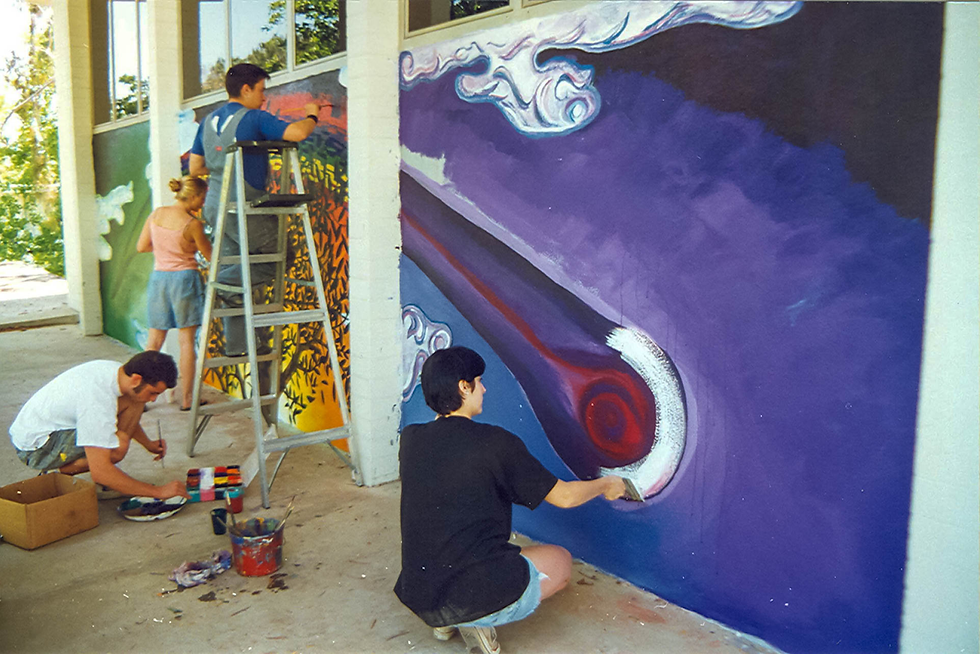
Whether it be the Benton Museum taking the time to create and host community events in Pomona to display Chicano artworks to the Gente community, or Pitzer College offering its insight into public art projects from its own student mural program on campus, it takes active efforts from our academic institutions to educate and inspire the Pomona community in order for the injustices experienced by Gente to be truly understood. By fostering a community that fully participates in the creation and viewing of public art murals, like the ones Gente created, we ensure that a century-long legacy of Chicano artivism will continue on in even the most challenging of political times.
Works Cited
“Gente Organizada Settles Suit with Pomona in Win for Free Speech .” ACLU of Southern California, 14 July 2025, www.aclusocal.org/press-releases/gente-organizada-settles-suit-pomona-win-free-speech/.
Goldman, Shifra M. “Siqueiros and Three Early Murals in Los Angeles.” Art Journal, vol. 33, no. 4, June 1974, pp. 321–327, https://doi.org/10.1080/00043249.1974.10793236.
Knight, Christopher. “Critic’s Notebook: LAUSD Caves to Claims of Racism on a School Mural. It’s Deplorable.” Los Angeles Times, Los Angeles Times, 13 Dec. 2018, www.latimes.com/entertainment/arts/la-et-cm-koreatown-mural-censorship-20181212-story.html.
Lucas, Julian. “Pomona Lost. Free Speech Won. And I Took the Pictures.” The Pomonan Magazine, The Pomonan Magazine, 16 July 2025, www.thepomonan.com/theopera/2025/7/15/pomona-lost-free-speech-won-and-i-took-the-pictures.
Mercado, Juan Pablo. “From Siqueiros to SPARC: The Historical and Ideological Roots of a Chicana Mural Movement.” Rewriting the Chicano Movement, 9 Mar. 2021, pp. 92–115, https://doi.org/10.2307/j.ctv1fcf84t.8.
Alex is a first-year student at Pomona College with a background and interest in using visual design for social justice, and understanding how art can be used to communicate ideas. They have particular interests in muralism and protest art.


